MVNDVS ALTER ET IDEM. Sive Terra Australis antehac semper incognita, longis itineribus peregrini Academici nuperrimè lustrata. Authore MERCVRIO BRITANNICO. Accessit propter assinitatem materiae THOMAE CAMPANELLAE, CIVITAS SOLIS. ET NOVA ATLANTIS. FRANC. BACONIS, Bar. de Verulamio. VLTRAIECTI, Apud Joannem à Waesberge Anno cIc Ic c XLIII [1643].
In 12º de 7,5x12,5 cm. com [16], 213, [19] págs.
Encadernação da época inteira de pergaminho rígido.
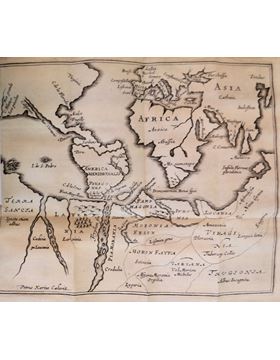
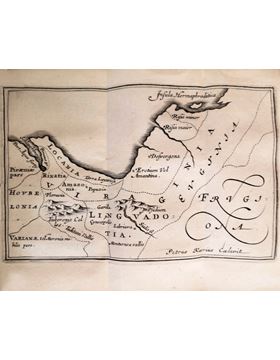
Ilustrado em extratexto com 4 mapas desdobráveis e 1 levantamento epigráfico impresso em chapa (páginas 64-65) .
Exemplar com ex-libris oleográficos desvanecidos no verso da folha de rosto.
Gravuras e mapas presentes no exemplar seguem a seguinte colação:
Frontispício com gravura de um banquete colocado no anterrosto.
Terra Sancta, Lavernia entre as págs. 32-33.
Pamphagonia entre as págs. 34-35.
Levantamento epigráfico entre as págs. 64-65.
Frugiona entre as págs. 98-99.
Moroniae entre as págs. 118-119.
Mare Pacifico del Sur entre as págs. 192-193.
Este trabalho é a primeira utopia sobre a Austrália, e a obra de Campanellas A Cidade do Sol e a de Bacon Nova Atlântida foram duas das mais reimpressas obras do século XVII sobre a utopia de uma república ideal (muitas vezes em conjunto com a Utopia de More e com a Oceana de Harrington). Este trabalho, publicado anonimamente, é provavelmente a primeira «distopia» (segundo McMullan, vide Politics of Unease, p. 236), e teve uma importante influência na obra As Viagens de Gulliver, de Swift.
Joseph Hall (1574-1656) foi um bispo inglês, satírico e moralista. Os seus contemporâneos conheciam-no como um escritor devocional, e um controverso de alto nível do início da década de 1640. Esta obra parece só ter sido atribuída formalmente a Hall em 1674, embora Milton tivesse atacado a obra, e o próprio Hall, na altura, por ser desprovida da mensagem moral necessária à sátira. No texto, o viajante fictício 'Mercurius Britannicus' visita quatro nações com nomes de origem latina, incluindo: Crapulia, Viraginia, Moronihah, e Lavernia (respectivamente, gula, luxúria, loucura e engano). O índice realça os vários nomes de lugares dentro de cada região para enfatizar a anedota. Os mapas ilustram o imaginário do continente australiano e antárctico, e com não-lugares também nas Américas (daí a sua inclusão nas bibliografias de Church e Sabin).
[EN] Duodecimo (twelvemo). 7,5x12,5 cm. [16], 213 [19] pp.
Binding: Contemporary hard parchment.
Illustrated with 4 maps and leaflets and 1 epigraphic survey printed plate (p. 64-65) “hors text”.
Copy with faded ex-libris stamps on the back of the title page.
The engravings and maps present in the book are in the following order:
Frontispiece with portrait of a banquet.
Terra Sancta, Lavernia between pp. 32-33.
Pamphagonia between pp. 34-35.
Epigraphic survey between pp. 64-65.
Frugiona between pp. 98-99.
Moroniae between pp. 118-119.
Mare Pacifico del Sur between pp. 192-193.
This work is the first utopia about Australia, and Campanellas´ A Cidade do Sol (The City of the Sun) and Bacon´s Nova Atlântida (New Atlantis) were two of the most widely reprinted seventeenth-century works on the utopia of an ideal republic (often in conjunction with More´s Utopia and Harrington’s Oceana) of all the 17th century works on the ideal republic. This anonymously published work is probably the first English «dystopia» (McMullan, Politics of Unease, p. 236) as well as an important influence on Swift’s As Viagens de Gulliver (Gulliver’s Travels’).
Joseph Hall (1574-1656) was an English bishop, satirist and moralist. His contemporaries knew him as a devotional writer, and a high-profile controversialist of the early 1640s. This work seems to have been only formally attributed to Hall in 1674, although Milton had attacked the work, and Hall himself, at the time, for being devoid of the moral message necessary to satire. In the text, the fictional traveler ‘Mercurius Britannicus’ visits four nations with names of latin origin, including: Crapulia, Viraginia, Moronihah, and Lavernia (respectively, gluttony, lust, madness and deception). The index highlights the various placenames within each region to emphasize the joke. The maps illustrate the imaginary Australis and Antarctic continent, and with non-places on the Americas as well (hence its inclusion in Church and Sabin).
Referências/References:
Sabin 29819; Gibson (Francis Bacon) 213. Firpo, Bibliografia, 2, pag. 95. Rarissimo. ESTC S103674; Church II 54; STC (rev.) 12685.3; Shaaber; British Authors Printed Abroad, H49; Alden & Landis, European Americana, 606/61.
For a detailed bibliographical study of the editions of this and their points, see: Papers of the Bibliographical Society of America, 74 (1980), pp. 1/12. On Hall, see: The Dictionary of National Biography, XXIV, 75/80. On the Jesuit library’s bibliography, see: Bib. Authors of Burgundy, P. Papillon, 1745.

 Português
 Inglês