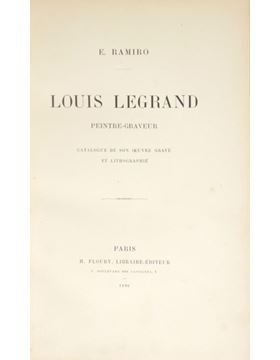
[Par] E. Ramiro. H. Floury, Libraire-Éditeur. Paris. 1896.
De 28x19 cm. Com [iv], vii, 109, [iv] págs. Encadernação com lombada em pele, com rótulo, nervos e ferros a ouro. Corte das folhas dourado e aparado à cabeça.
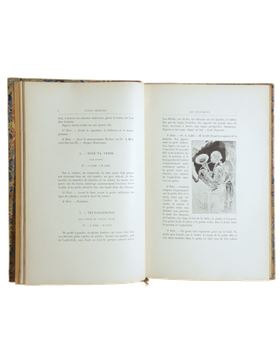
Ilustrado no texto com gravuras, vinhetas e bonitas iniciais decoradas; e em extratexto com 7 reproduções de muita qualidade sobre papel encorpado.
Exemplar n.º 68 de uma tiragem de apenas 200, sobre papel velino. Pequena falha de pele na coifa inferior. Preserva as capas de brochura.
Etiqueta do encadernador onde se lê «Relieure Franz, Ostermann, Paris».
Este catálogo apresenta o corpo de trabalho de Legrand, reproduzindo as gravuras do artista com os melhores padrões de impressão.
Erastene Ramiro é pseudónimo de Eugène Rodrigues-Henriques (Paris, 1853 – Paris, 1928), que foi advogado, bibliófilo e bibliógrafo.
Louis Auguste Mathieu Legrand (Dijon, 1863 – [?], 1951) foi um artista francês, conhecido sobretudo pelas suas gravuras em água-forte, por vezes eróticas. Estudou pintura na Escola de Belas-Artes em Dijon. Mudou-se para Paris em 1884 e conheceu o mestre gravador Felicien Rops, que o orientou na arte da gravura e da litografia. Tal como Rops, retratou frequentemente prostitutas e cenas da vida nocturna parisiense e, na viragem do século, chegou mesmo a estabelecer o seu estúdio no Moulin Rouge.
Duas das suas obras satíricas, «Prostituição» e «Naturalismo», levaram-no a um processo por obscenidade. Rops colocou Legrand em contacto com um amigo advogado, Eugéne Rodrigues, para o defender. Além de exercer a advocacia, Eugéne era também bibliófilo e biliógrafo. Tornaram-se amigos e após uma curta pena de prisão começaram a colaborar em projectos criativos. De destacar que no autorretrato que consta da capa anterior está inscrito «a Eug. Rodrigues, mon meilleur ami.» (a Eug. Rodrigues, o meu melhor amigo).
Os conhecimentos técnicos de Legrand foram reconhecidos pela academia, tendo sido galardoado com a Légion d’honneur em 1906.
[EN] 28x19 cm. [iv], vii, 109, [iv] pp. Bound with leather spine, with label, raised bands and gilt tools. Top trimmed gilt edges.
Illustrated in the text with engravings, vignettes and beautiful decorated initials; and hors-texte with 7 high-quality reproductions on thick paper.
Copy no. 68 of a print run of only 200, on vellum paper. Small leather flaw on the lower spinecap. Preserves the paperback covers.
Binder"s label reads 'Relieure Franz, Ostermann, Paris'.
This catalog presents Legrand"s body of work, reproducing the artist"s prints with the best printing standards.
Erastene Ramiro is the pseudonym of Eugène Rodrigues-Henriques (Paris, 1853 - Paris, 1928), who was a lawyer, bibliophile and bibliographer.
Louis Auguste Mathieu Legrand (Dijon, 1863 - [?], 1951) was a French artist, known above all for his etchings, sometimes erotic. He studied painting at the School of Fine Arts in Dijon. He moved to Paris in 1884 and met the master engraver Felicien Rops, who guided him in the art of engraving and lithography. Like Rops, he often depicted prostitutes and scenes from Parisian nightlife and, at the turn of the century, even set up his studio in the Moulin Rouge.
Two of his satirical works, 'Prostitution' and 'Naturalism', led to him being prosecuted for obscenity. Rops put Legrand in touch with a lawyer friend, Eugéne Rodrigues, to defend him. As well as practicing law, Eugéne was also a bibliophile and bibliographer. They became friends and after a short prison sentence they began collaborating on creative projects. It should be noted that the self-portrait on the front cover is inscribed 'a Eug. Rodrigues, mon meilleur ami.' (to Eug. Rodrigues, my best friend).
Legrand"s technical expertise was recognized by the academy, and he was awarded the Légion d"honneur in 1906.

 Português
 Inglês